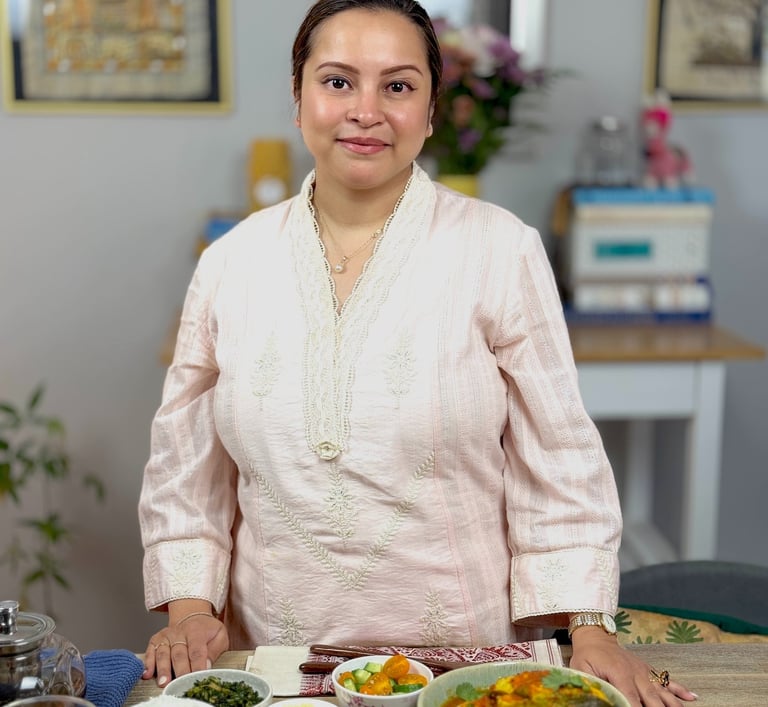

In Conversation with Shenaz GK
On Assamese food, an invisible diaspora, and a recipe for the quintessential Maasor Tenga
Shenaz GK, Tanushree Kulkarni
6/17/20267 min read
The magnificent, fertile, fragrant, and gorgeously green state of Assam sits in the northeastern corner of India, connected to the rest of the country by what is still sometimes called the Chicken's Neck, a narrow strip of land roughly 22 kilometers wide, flanked by Nepal to the north and Bangladesh to the south. This geographical bottleneck has shaped the state's politics, its history, and certainly its food.
The Brahmaputra river runs through Assam like a spine. It floods annually, depositing some of the most fertile silt on earth, and the cuisine that developed around it reflects this intimacy with water and season. Freshwater fish are central, and so are dozens of varieties of wild greens gathered from fields, riverbanks, and forests. Assam has over 200 documented varieties of rice, central to the culinary fabric.
“Rice is crucial because Assamese people believe in communal eating,” says Shenaz.
She grew up in Assam, in her mother's kitchen garden, watching her mother and grandmother cook with what she describes as love and intention. She went on to become a lawyer, then a humanitarian worker with the United Nations Refugee Agency, serving in four countries across South and Southeast Asia and North and East Africa. What she observed, consistently, was that one of the things refugees reached for to recreate memories of their homeland is food. This inspired her to think beyond food and focus on food stories.
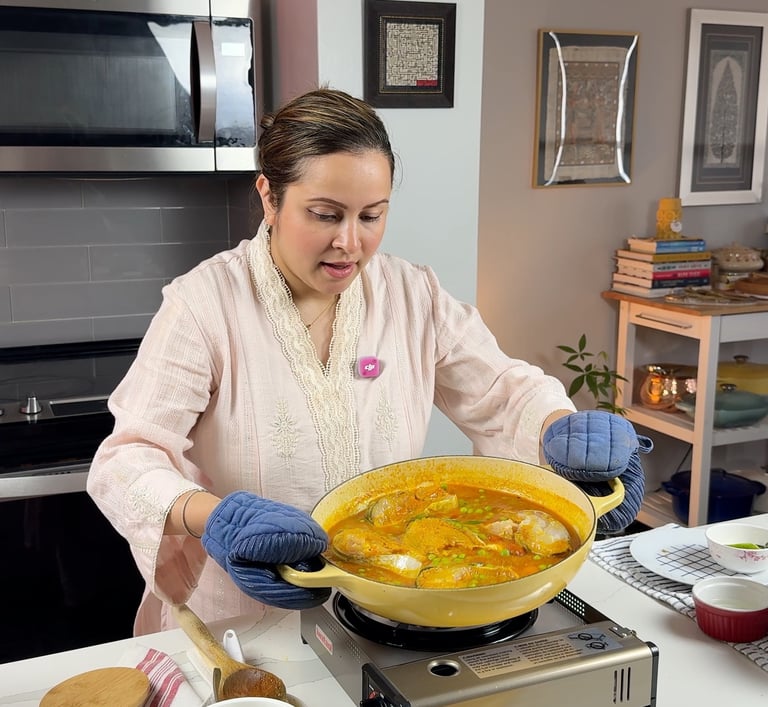
Shenaz now lives in Toronto with her husband Ahmer, where together they create food content for her channel Naz It Up. Assamese food and memories of a home kitchen traveled with her and live in her kitchen, on her channel, and in her hands. Whether it travels further depends on whether anyone is paying attention.
Geographically and culturally, Assam has long had more in common with Southeast Asia than the larger Indian subcontinent. The Ahom people who ruled the region for six centuries originally came from present-day Myanmar. The food reflects this, as it is characterized by fermentation, bamboo shoots, minimal use of oil, the wrapping of ingredients in banana leaves, and a fondness for smoke and sourness. These are not the flavors of North Indian cooking, or cooking categorized as “South Asian” in North America. They are something older in philosophy and design.
Food historian Colleen Taylor Sen wrote in her authoritative Feasts and Fasts: A History of Food in India that the Assamese are virtually alone in preserving the six basic tastes of ancient Indian gastronomy: sweet, sour, bitter, salty, pungent, and astringent, with the alkaline khar dish representing a flavor category that is, as she put it, probably unique in the world of food. A traditional Assamese meal begins with khar to open the palate and ends with tenga, a sour dish, often fish-based, to close it. This is a philosophy of eating with a documented, millennia-long lineage.
The dining trends that dominate food media today, namely fermentation, indigenous knowledge, hyper-local ingredients, seasonal eating, culinary biodiversity, and restraint over excess, are not new ideas in Assam but foundational ones.
Communities across the state were fermenting bamboo shoots, fish paste, rice, and leafy vegetables long before fermentation became a technique in vogue. Assamese households gather dozens of varieties of wild greens, described as "foraged" when they appear on tasting menus. The concept of tying food to ecosystem and season, rather than supply chain and trend, is built into Assamese cooking at the structural level. In another era, Assamese food might have been dismissed as too unfamiliar. But today, by the metrics the food industry professes to care about, it is almost exactly what is being looked for.
So why is it still hidden in the diaspora as Indian food expands to feature regional cuisines?
There is a word in Assamese — lahe lahe — that translates literally as "slowly, slowly." It describes a pace of life, an orientation toward time and urgency that is the opposite of promotional hustle. In Assam, lahe lahe is less a philosophy than a condition of being. Captain P.R. Gurdon, a British administrator posted in Goalpara at the turn of the twentieth century, noted it in his compilation of Assamese proverbs and found it characteristic of the people he encountered. Whatever they did, they did slowly, mindfully, peacefully. Assamese cuisine absorbed this spirit and was not built for spectacle. It was built for sustenance, for ecology, for the particular pleasures of a people who knew they were eating well and did not need anyone else to confirm it.
As Shenaz puts it simply: “the unhurried lahe-lahe culture of the Assamese people meant they never felt their food needed mainstream popularity.” But she also concurs that perhaps that indifference to external validation has cost the cuisine in the age of food media. She believes it is the shared responsibility of those in the diaspora to talk more about their food culture.
The vast global appetite for Assam tea, which is robust, malty, the backbone of most British breakfast blends, and for chai, which has become a marker of identity for the South Asian diaspora, has not translated into any meaningful curiosity about what people in Assam eat alongside that tea, or before it, or instead of it. Somehow, the familiarity with chai has not opened the door to its cuisine. Instead, it sits parallel to it, visible but disconnected, like something seen through glass.
Given the invisibility, it may be surprising that the Assamese diaspora in North America is older than most people assume. The Assam Society of America was informally organized in the 1960s in the New York–New Jersey area, among some of the earliest Assamese immigrants to the United States. By 1980, the Assam Association of North America had been formally founded in Houston, Texas, with a national conference and a mission centered on cultural preservation, language continuity, and community identity.
That is over four decades of organized diaspora life.
And yet Assamese cuisine has no commercial footprint in North America to speak of and a lack of restaurant ecosystem. This also sheds light on the idea that a cuisine from within the larger diaspora can be thriving and invisible at the same time. In thousands of homes across North America, Assamese families are cooking khar, fish tenga, duck with ash gourd, pitikas, and pithas every week. That cooking is real, alive, and largely unknown beyond the people eating it.
Even when Assamese food gets attention on its own terms, it tends to be filtered through a handful of signature ingredients: bamboo shoots, pork, and the bhut jolokia- the ghost pepper. These are real parts of the food culture, but they are its extremities, not its soul. Assamese food is characterized by mildness, balance, and nutritional depth. It is a cuisine of restraint.
The reduction to exotica makes Assamese food seem like a curiosity rather than an everyday tradition. It gives outsiders no entry point into the midday bowl of rice and Maasor Tenga, into the morning khar that opens the stomach, into the afternoon rest that follows a proper meal.
SHENAZ'S RECIPE FOR MAASOR TENGA
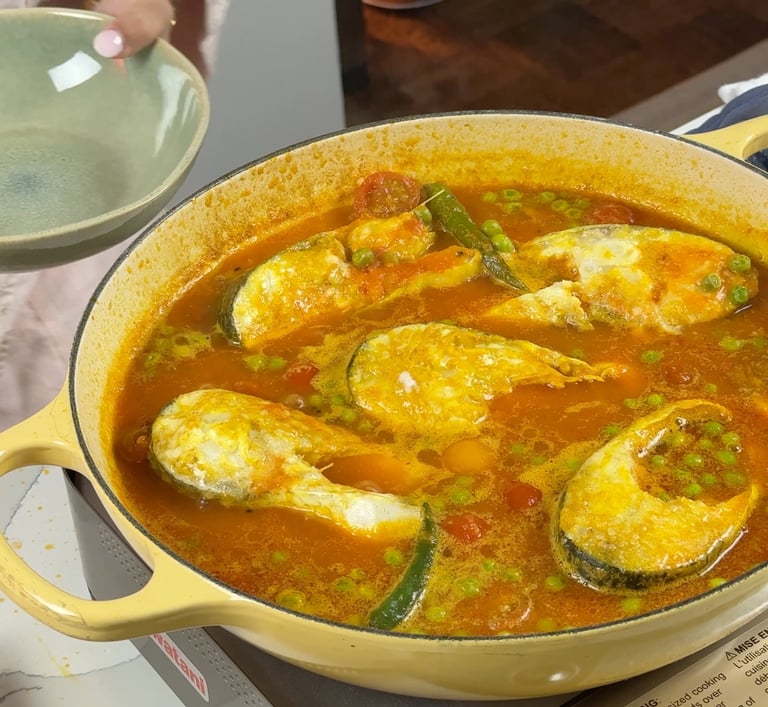
Shenaz's recipe for Maasor Tenga is, in microcosm, an argument about what makes Assamese food distinctive, and why that distinctiveness resists easy translation into the categories through which most Western diners understand Indian cooking.
The dish begins with mustard oil, the defining fat of the Assamese kitchen. It is pungent, nose-tingling when heated, unlike anything in the olive oil or neutral-oil vocabulary of Western cooking. It is also one of the first things likely to be substituted away in diaspora cooking, replaced with canola or vegetable oil because it is harder to find, or because the smell is unfamiliar to non-Assamese partners and neighbors. Each substitution is a small negotiation between memory and circumstance.
Then there is panch phoron — a five-spice blend of mustard, cumin, fennel, fenugreek, and nigella seeds. The sourness of Maasor Tenga (tenga means sour) comes last, adjusted to personal preference with lime juice, though in Assam it might come from outenga (elephant apple) or from sun-dried thekera, a dried form of Garcinia. Each souring agent produces a different quality of tartness. The elephant apple is fruity and floral. The thekera is earthier, more resinous. Neither is available in most North American stores, so the recipe adapts and memory persists. Every family has their own way of making Maasor Tenga, and each version is delicious. After enjoying the preparation with a bowl of rice, an afternoon nap feels almost inevitable.
List of Ingredients
5–6 pieces of freshwater fish steaks, 1–2 inch thick (500–700 g)
1 tsp ground turmeric to marinate the fish
1 tsp salt to marinate the fish
½ tsp ground turmeric for Maasor Tenga
2 tbsp mustard oil
3 cloves of garlic, sliced
1 tsp panch phoron (five-spice blend)
5 medium-sized fresh tomatoes (pureed or diced)
1 tsp ground cumin
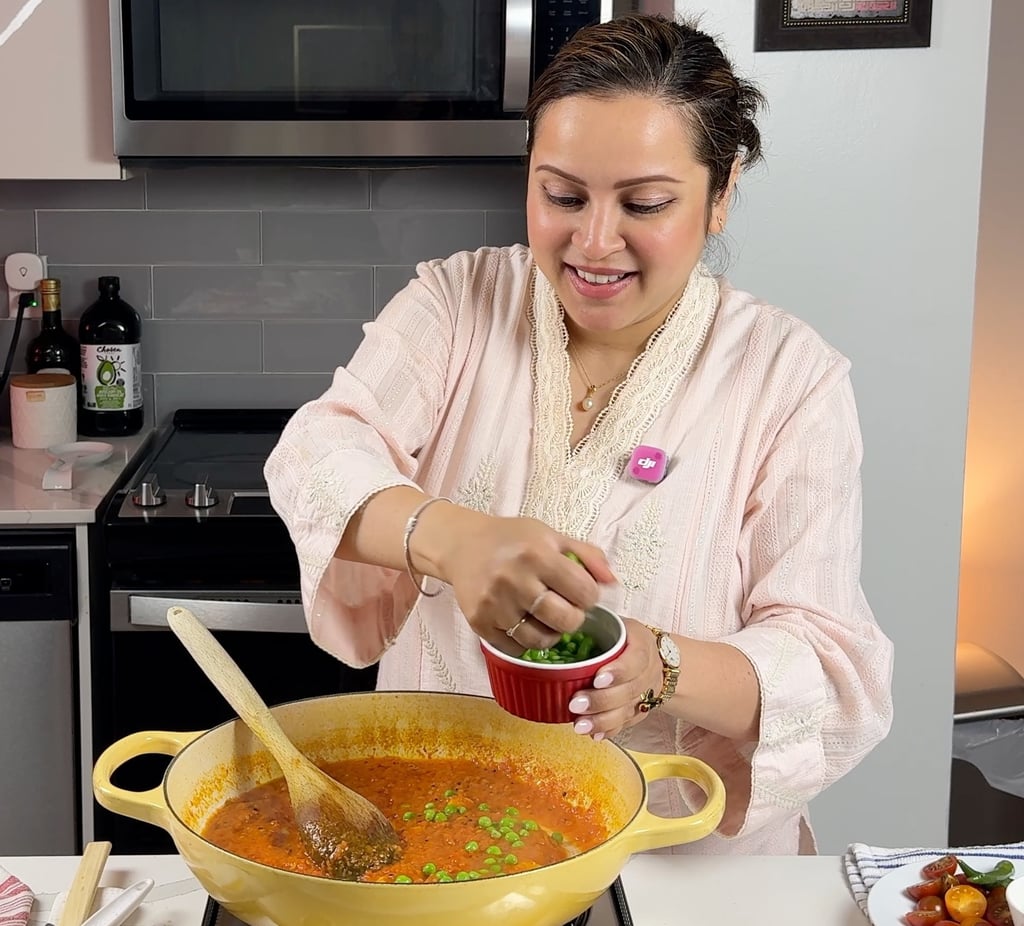
1 cup peas (fresh or frozen)
2 green chilies
Salt to taste for Maasor Tenga (stew)
Juice of ½ a lime
Cilantro (garnish)
Method
Step 1: If the fish is bought fresh from the monger, washing the fish steaks in salty water is recommended. Pat dry after washing.
Step 2: Marinate the fish in salt and turmeric.
Step 3: Fry the fish in mustard oil (this is optional)
Step 4: Heat a kadhai or shallow cooking pot, add mustard oil. When the oil heats, you will be able to smell a nose-tingling aroma. Bring the flame to low, add sliced garlic and panch phoron, allow to sizzle. Add pureed tomatoes, cover, and let it cook on medium heat for 10–15 min. Stir occasionally. Once the excess moisture from the tomatoes has evaporated, add turmeric and ground cumin. Mix well and cook for 5 min until ground spices are cooked. Next, add the peas, partially slit whole chilies, and gently place the marinated fish. Add warm water to partially submerge the fish steaks. Add salt and do not stir. Instead, swirl the cooking pot a couple of times. Cover and let the fish cook for 10–15 min on medium to low flame. Add lime juice to make the stew tangy to your personal preference. Garnish with fresh cilantro before serving. Pairs well with steamed rice.
Substitutes
Mustard oil is a quintessential ingredient in the Assamese kitchen. If one does not have mustard oil, any neutral oil can be used in its place.
Panch phoron is sold as panch phoron at Indian and Bangladeshi stores. If one does not have it in the pantry, then ½ tsp fenugreek and ½ tsp mustard seeds can be used.
BEYOND THE RECIPE
Shenaz is one of a handful of food content creators in the Assamese diaspora. Follow her on Instagram and YouTube for an insight into Assamese food culture and the full video on the preparation of Maasor Tenga.
A decade from now, will Assam be known through its food in the diaspora? That depends on whether Assamese cuisine remains confined to memory and community halls, or whether it finally claims the space it has always deserved.
Shenaz GK is doing her part from a kitchen in Toronto through Naz It Up.